
- Written: January 23, 2026
- Written by: Amanda Conway
If you’re leading logistics for a mid-market DTC brand, 2026 presents a critical decision point. The 3PL market is consolidating rapidly—major acquisitions are reshaping the vendor landscape weekly.
According to GoBolt’s 2025 State of Logistics Report (which surveyed 263 brands across North America), 59% of companies have changed 3PL providers multiple times due to ongoing delivery issues. Choose the wrong partner now, and you’re likely joining them in another disruptive switch within 12-18 months.
This guide provides strategic decision-making intelligence for ops directors and supply chain leaders evaluating Canadian 3PL partners.
You’ll get market landscape analysis, consolidation trends reshaping provider stability, what makes Canadian fulfillment strategically distinct, and an evaluation checklist you can download.
What's in this Guide
Key Takeaways: 3PL Selection Criteria for 2026
When evaluating Canadian 3PL providers, prioritize these critical factors based on what brands actually need:
- The speed vs. cost tradeoff is a false choice: 67% of brands cite cost competitiveness as most important when selecting a 3PL, yet 73% prioritize delivery speed and reliability. Modern 3PL providers must deliver both through carrier diversification
- Delivery delays drive provider switches: 68% cite frequent delivery delays as a significant operational pain point, and 65% say issues between fulfillment and last-mile carriers negatively impact customer experience
- Integrated fulfillment delivers measurable value: 92% of brands see significant or moderate benefit from a 3PL that seamlessly integrates fulfillment and last-mile delivery into a single solution
- Technology investment gaps persist: 68% of brands want their 3PL to invest in carrier diversification capabilities, 52% prioritize warehouse automation, and 49% demand advanced inventory management
- Canadian regulatory expertise: CBSA compliance, bilingual labeling requirements, and provincial regulatory navigation separate qualified providers from generalists
- Sustainability is non-negotiable: 51% of brands value partnering with sustainable carriers, and 65% see route optimization for fuel efficiency as valuable to their organization
TL;DR - What You Need to Know About Canadian 3PL Selection in 2026
The Canadian 3PL market is expected to reach 27.98 billion USD by 2030, but the landscape is shifting rapidly:
- Why brands switch: Cost is #1 reason brands change providers, but delivery speed and reliability is #1 reason they select a new one [GoBolt State of Logistics Report, 2025]
- Consolidation signal: UPS/Andlauer ($1.6B), TFI/Hercules ($100M+) indicate shift toward specialized providers over pure scale players
- Canadian market opportunity: $130B ecommerce market by 2027, with localized fulfillment unlocking faster delivery and higher conversion rates
- Carrier diversification delivers: 65% of brands believe diversifying carriers leads to cost reductions, and 55% cite improved delivery speed [GoBolt State of Logistics Report, 2025]
- Integrated models win: 92% see value in fulfillment + last-mile under one roof [GoBolt State of Logistics Report, 2025]
The 2026 Canadian 3PL Market: Consolidation, Growth, and Strategic Implications
Market Size and Growth Trajectory
The Canadian 3PL market was valued at 22.37 billion in 2025 and is projected to reach $27.98 billion by 2030, growing at 4.58% CAGR. Ecommerce drives this growth: Canada had over 27 million ecommerce users in 2022 (75% penetration), expected to hit 77.6% in 2025 with retail e-commerce sales reaching $40.3 billion.
Cross-border trade expansion following USMCA creates additional complexity and opportunity. The treaty streamlined processes between the US and Canada, but you need genuine cross-border capabilities rather than partner referrals in another country.
What this means for your brand: More provider options than ever, but the market is fragmenting between technology-enabled specialists and traditional asset-based carriers. According to GoBolt’s research, brands are prioritizing fundamentally different capabilities during selection versus switching decisions.
Meaning: they choose based on speed but leave due to cost. Getting both right from the start prevents costly migrations.
Geographic concentration matters. Service providers cluster near customers for efficient last-mile delivery, with Ontario experiencing maximum warehousing infrastructure development. Proximity to distribution hubs directly impacts your delivery speed and shipping costs.
The Consolidation Wave Reshaping Provider Stability
2024-2025 marked dramatic consolidation acceleration. UPS’s $1.6 billion acquisition of Andlauer Healthcare Group added 34 temperature-controlled sites, signaling market shift toward domain specialization over pure scale. TFI International’s $100+ million purchase of Hercules Forwarding reinforced cross-border LTL capabilities. Both underscore a strategic trend that should inform vendor selection.
Why consolidation matters: When your 3PL gets acquired, expect potential service disruption, price increases, or forced system migrations. Integration periods typically last 12-18 months—precisely when service quality slips. With 59% of brands having already switched providers multiple times, choosing stable, well-capitalized partners from the start reduces repeat migration risk significantly.
Driving forces behind consolidation:
- Technology investment requirements: Modern WMS, real-time tracking, and predictive analytics require capital smaller providers lack
- EV fleet deployment economics: Meeting sustainability commitments demands significant upfront investment—51% of brands now value partnering with sustainable carriers
- Integrated service demand: 92% of brands see value in fulfillment and last-mile under one roof, not cobbled through multiple vendors
- Carrier diversification capabilities: 68% of brands want their 3PL to expand shipping options
- Vendor selection implication: Prioritize providers with strong financial backing, proprietary technology platforms, and specialized capabilities over generic scale players who may become acquisition targets themselves.
What Brands Actually Want: Technology, Speed, and Cost
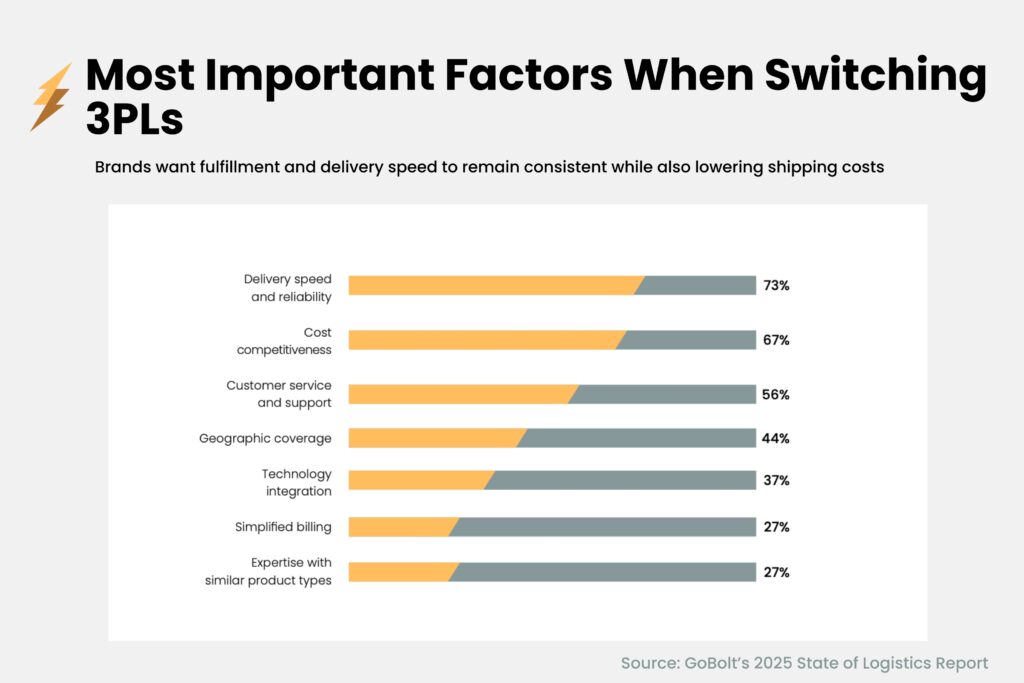
The data from GoBolt’s State of Logistics Report reveals a critical insight: brands refuse to choose between speed and cost. When selecting a 3PL, the priorities are clear:
Top factors when selecting a 3PL:
- 73% – Delivery speed and reliability
- 67% – Cost competitiveness
- 56% – Customer service and support
- 44% – Geographic coverage
- 37% – Technology integration
Yet despite cost being a primary selection criterion, speed problems drive provider changes. This apparent contradiction reveals that brands expect competitive pricing as table stakes, then differentiate providers based on delivery performance and reliability.
The technology gap: 68% of brands want their 3PLs to invest in carrier diversification capabilities, 52% prioritize warehouse automation, and 49% demand better inventory management systems.
What to evaluate during demos (not just “do they have technology”):
- WMS capabilities with real-time updates, not daily batch processing
- Native API integrations with Shopify, WooCommerce, BigCommerce
- Real-time inventory visibility across all warehouse locations
- Last-mile performance and delivery tracking (77% of startups say this is critical)
- Automated exception management resolving issues before they reach your CS team
Technology gaps create competitive disadvantages. Without real-time inventory visibility, you’re either overselling (disappointing customers) or holding excess safety stock (killing margins). Without direct Shopify integration, you’re manually reconciling inventory and hoping nothing falls through during peak season.
Quick 3PL Evaluation Checklist
Before scheduling demos with potential providers, use this checklist to pre-qualify vendors and save evaluation time:
Technology & Integration
☐ Native Shopify/WooCommerce/BigCommerce integrations
☐ Real-time inventory visibility across all warehouse locations
☐ Public API documentation available for review
☐ System uptime SLA of 99.5%+ in writing
☐ Inventory & order tracking
☐ Last-mile performance and cost tracking capabilities
Canadian Operations Expertise
☐ Demonstrated CBSA (Canadian Border Services Agency) expertise
☐ In-house customs brokerage capabilities
☐ Proven bilingual labeling compliance experience
☐ Understanding of provincial regulatory variations
☐ Warehouse locations in Toronto, Montreal, or Vancouver
Financial Stability & Scalability
☐ Clear ownership structure (PE-backed, family-owned, publicly traded)
☐ Technology investment trajectory (8-12% of revenue minimum)
☐ Customer retention rate
☐ Current warehouse utilization
☐ Expansion plans for next 12-24 months documented
Service Quality & Performance
☐ Client references in your industry and order volume range (3-5 contacts)
☐ Documented SLAs
☐ Order accuracy rates above 99.5%
☐ Average order processing time under 24 hours
☐ Inventory accuracy rates above 99%
☐ Check their Google Reviews to see what the end shopper is saying
Carrier Diversification & Delivery
☐ Partnerships with 4+ carriers (not just FedEx/UPS)
☐ Proven track record reducing delivery delays
☐ Transparent rate cards and shipping cost breakdown
☐ Route optimization capabilities
☐ Flexible carrier selection based on cost and speed
Sustainability Commitments
☐ EV delivery percentage
☐ Transparent emissions reporting
☐ Verified carbon offset programs (not just purchased credits)
☐ Sustainable packaging options available
Pricing Transparency
☐ Detailed breakdown of all fees (receiving, storage, picking, packing, special handling)
☐ Shipping costs clearly explained (negotiated carrier rates vs. markup)
☐ No hidden monthly minimums or volume commitments
☐ Seasonal surcharge policy documented
☐ Sample invoices from current clients reviewed
What Makes Canadian Fulfillment Strategically Different
Cross-Border Trade Dynamics in 2026
The USMCA eliminated tariffs on Canadian-purchased goods manufactured in the United States, though Canadian customers still pay tariffs on components made outside the US. Cross-border shipping complexity has increased significantly in 2025-2026 due to evolving tariff policies and trade enforcement changes.
Current cross-border reality: The de minimis exemption landscape has shifted dramatically. While USMCA provides benefits for qualifying goods, brands must navigate a more complex regulatory environment than in previous years. The strategic value of Canadian fulfillment now centers on serving Canadian customers efficiently, not manipulating duty structures.
Freight shipping from Canada to the US falls into three customs entry categories: informal entry (under $2,500), formal entry (over $2,500), and specialized treatment for specific product categories. Understanding Harmonized System (HS) codes and proper classification is critical.
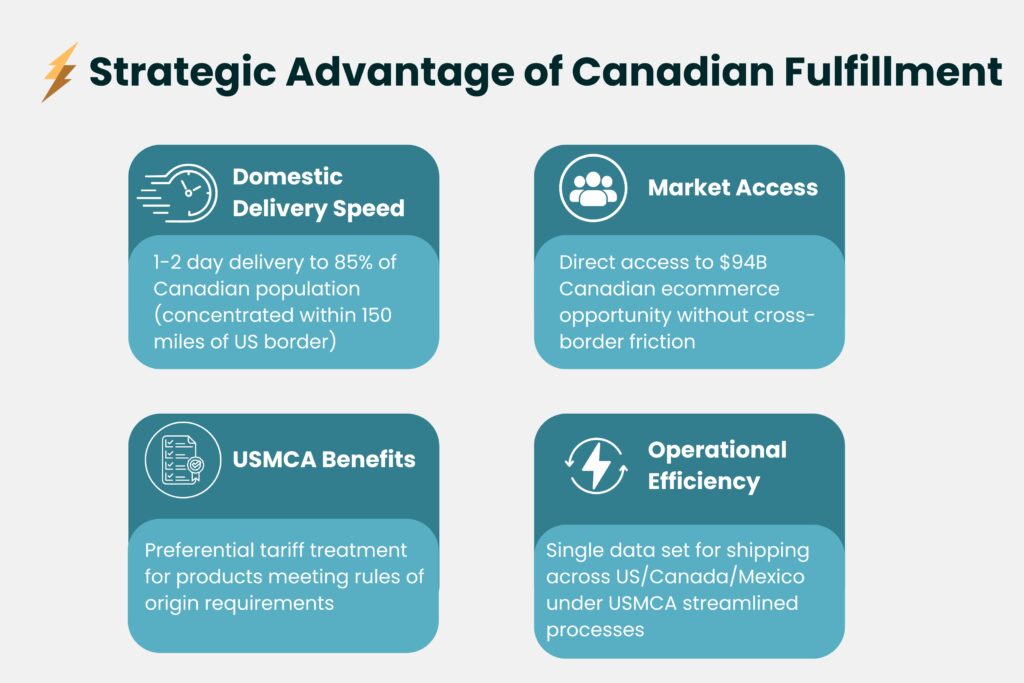
The actual strategic advantages of Canadian fulfillment in 2026:
- Domestic delivery speed for Canadian orders: 1-2 day delivery to 85% of Canadian population (concentrated within 150 miles of US border)
- Market access: Direct access to $130B Canadian ecommerce opportunity without cross-border friction
- USMCA benefits for qualifying goods: Preferential tariff treatment for products meeting rules of origin requirements
- Operational efficiency: Single data set for shipping across US/Canada/Mexico under USMCA streamlined processes
Regulatory Navigation Requirements
Canadian fulfillment means navigating unique regulatory and operational requirements:
CBSA (Canadian Border Services Agency) compliance: Import documentation, duty classification, and customs clearance require specialized expertise. Generic 3PLs with “a warehouse in Canada” aren’t the same as providers with expertise in customs brokerage and CBSA relationship management.
Bilingual labeling requirements: Federal law requires French and English on consumer packaging in many categories. Your 3PL should understand these requirements and help with compliance, not discover violations after inventory arrives.
Provincial regulatory variations:
Different provinces have distinct rules around product categories, labeling, and taxation. British Columbia regulations differ from Ontario’s, which differ from Quebec’s. Your provider should navigate these automatically.
The Hidden Cost of Delivery Delays
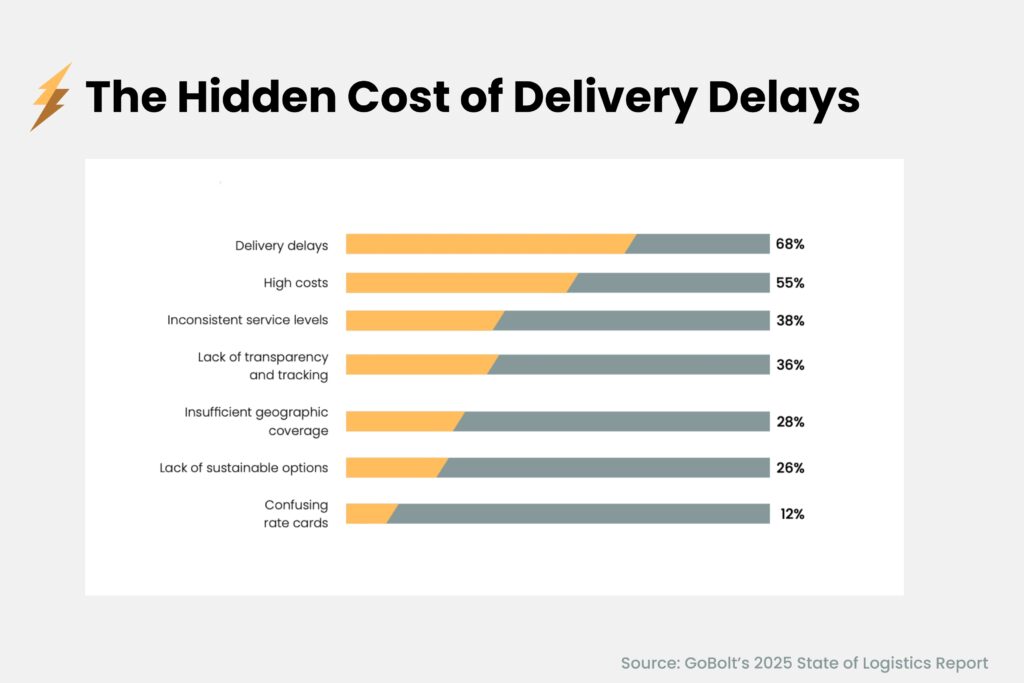
According to GoBolt’s State of Logistics Report, delivery performance is the silent killer of 3PL relationships:
The scope of the problem:
- 68% of brands cite frequent delivery delays as a significant operational pain point
- 65% say issues between fulfillment and last-mile carrier negatively impact customer experience
- 59% of brands have changed 3PL providers multiple times due to ongoing delivery issues
What’s behind delivery delays:
Most delays occur at the handoff point between fulfillment operations and last-mile carriers. When your 3PL says “we fulfilled the order on time, but the carrier was late,” they’re technically correct and completely missing the point. Your customer doesn’t care where the failure occurred; they just know their order is late.
Top last-mile challenges brands face:
- Delivery delays (68%)
- High costs (55%)
- Inconsistent service levels (38%)
- Insufficient geographic coverage (36%)
- Lack of transparency and tracking (28%)
*Source: GoBolt’s 2025 State of Logistics Report
Why this matters for vendor selection: 59% of brands have switched providers multiple times, indicating the problem compounds. Each migration costs time, money, and operational focus. Choosing a provider with integrated fulfillment and last-mile delivery from the start eliminates the finger-pointing and reduces delays at the most critical handoff point.
Essential 3PL Evaluation Criteria: Technology, Integration & Sustainability
Carrier Diversification: The Key to Balancing Speed and Cost
One of the most revealing findings from GoBolt’s research: brands recognize carrier diversification benefits but struggle to implement it effectively.
The value is clear
- 65% believe diversifying carriers leads to cost reductions
- 55% cite improved delivery speed
- 43% value risk mitigation from multiple carrier options
- Yet 59% find it challenging to manage costs across multiple carriers
What brands want from their 3PL:
- 68% want 3PLs to invest in shipping/carrier diversification capabilities
- 52% prioritize warehouse automation
- 49% demand better inventory management systems
- 36% need simplified invoicing
The implementation challenge: Despite recognizing the benefits, most brands rely heavily on just 2-3 carriers (primarily FedEx and UPS). This creates single-point-of-failure risk and limits negotiating leverage. The solution isn’t for brands to manage multiple carrier relationships themselves; it’s choosing a 3PL that has already built those partnerships and can intelligently route shipments based on cost, speed, and reliability.
Evaluation questions: How many carrier partnerships does your 3PL maintain? Can they automatically route shipments based on cost and speed optimization? Do they provide unified tracking across all carriers, or will you need to check multiple systems?
Technology Evaluation: Beyond the Demo
Startups report unique challenges compared to scaling or mature brands. According to GoBolt’s research:
Startup priorities (different from established brands):
- 77% say last-mile performance and cost tracking are critical technologies
- 54% highlight real-time inventory tracking as essential
- 54% cite poor geographic coverage as top frustration with shipping partners
- 39% report lack of tracking transparency as a major pain point
What this means: Early-stage brands have leaner operations, making gaps in shipping coverage and tracking visibility more impactful. If you can’t see where inventory is in real-time or how much last-mile delivery actually costs, you’re flying blind during your most critical growth phase.
Red flags during technology demos:
- “We’re working on that feature” (vaporware that won’t ship)
- Reliance on CSV file exports/imports for routine operations
- Batch updates described as “real-time”
- Unable to provide API documentation
- Manual data entry for routine operations
- Multiple system logins required for basic visibility
Integrated Fulfillment + Last-Mile vs Multi-Vendor Approaches
The data on integrated operations is striking: 92% of brands see significant (35%) or moderate (46%) benefit from a 3PL that seamlessly integrates fulfillment and last-mile delivery into a single solution.
Why integration matters:
When fulfillment and last-mile delivery are managed by separate companies, accountability fragments. Your 3PL blames the carrier, the carrier blames the 3PL, and you’re stuck mediating while your customer waits. Exception management slows to a crawl because it requires coordination between organizations with different systems, priorities, and SLAs.
Integrated Fulfillment vs Multi-Vendor Model: Direct Comparison
Factor | Integrated Fulfillment + Last-Mile Model | Traditional Multi-Vendor Approach |
Accountability | Single point of contact; no finger-pointing when issues occur | Must coordinate between separate warehousing, carrier, and returns providers |
Technology Platform | Unified dashboard for inventory, orders, tracking, delivery | Multiple logins across different systems; manual data reconciliation |
Exception Management | Provider controls entire chain; can resolve issues proactively | Vendor blame game; delays while providers coordinate |
Cost Structure | Vertical integration eliminates handoff inefficiencies | Multiple markup layers; coordination overhead |
Delivery Speed | Optimized routing from warehouse to doorstep | Delays at handoff points between providers |
Visibility | Real-time tracking from pick to delivery | Tracking gaps when shipments change hands |
Premium Services | White-glove delivery, assembly, installation available | Limited to what third-party carriers offer |
Customer Experience | Consistent brand experience through unboxing | Variable quality across different touchpoints |
Implementation | Single onboarding; one integration project | Multiple integrations; ongoing vendor management |
Problem Resolution Time | Hours (internal escalation) | Days (cross-vendor coordination) |
Bottom line: With 65% of brands reporting that issues between fulfillment and last-mile carriers negatively impact customer experience, and 68% citing frequent delivery delays as a pain point, the integrated model directly addresses the #1 driver of 3PL switches.
Evaluation questions: Do they own last-mile operations or contract with carriers? What percentage of deliveries do they control end-to-end? How does exception management work across fulfillment and delivery? Does their platform provide unified visibility, or separate systems for warehouse and transport data?
Sustainability: Differentiator or Greenwashing?
Sustainability has moved from “nice-to-have” to competitive requirement. According to GoBolt’s State of Logistics Report:
- 51% of brands value partnering with sustainable carriers
- 65% see route optimization for fuel efficiency as valuable
- 46% want eco-friendly packaging
- 34% want electric-vehicle delivery options
The challenge is separating genuine commitment from greenwashing. Vague claims about “carbon-neutral shipping” often mean the company purchased offsets, not that they’re actually reducing emissions.
What to evaluate:
- EV delivery percentage: “We’re committed to sustainability” is marketing. “We currently operate 30% EV deliveries and project 60% by 2027” is a measurable commitment.
- Transparent emissions reporting: Can they show you carbon emissions you’ve avoided? Do they provide data you can include in your own sustainability reporting? Or do they just say “we offset everything”?
- Verified carbon offsets: Are offsets verified by recognized third-party organizations, or just purchased carbon credits? What’s the quality and permanence of the offset projects?
- Route optimization: Do they use technology to minimize miles driven and consolidate deliveries, or are they just buying offsets to compensate for inefficient operations?
Value-Added Services: Returns, Wholesale, and Custom Solutions
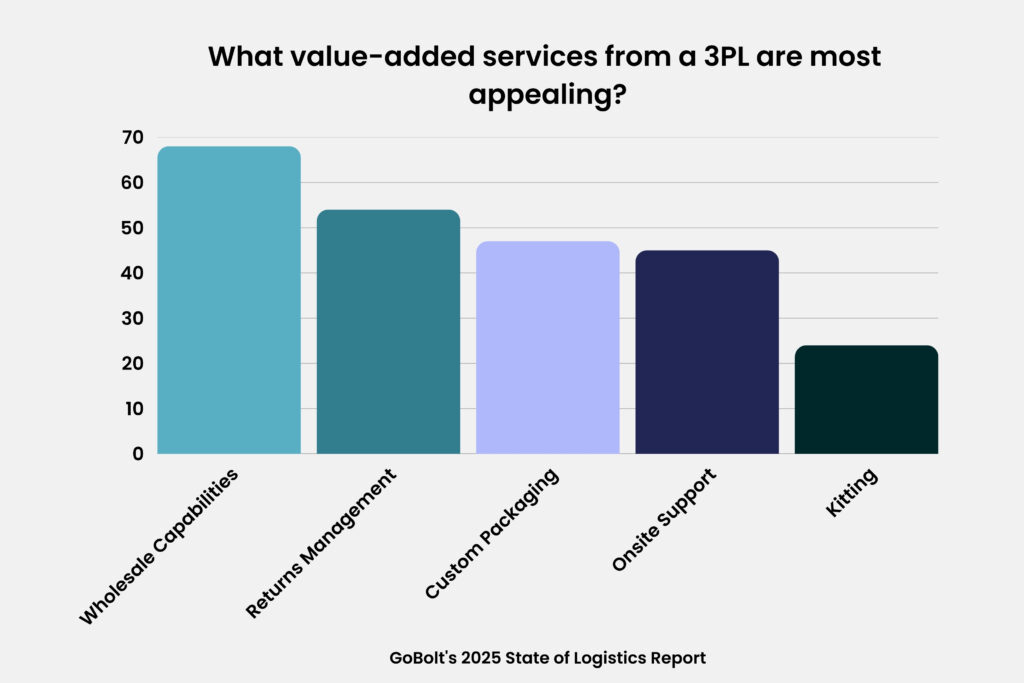
Beyond core fulfillment and delivery, brands increasingly need specialized capabilities. GoBolt’s research reveals what actually matters:
Most appealing value-added services:
- Returns management: 49-58% (depending on business stage)
- Wholesale capabilities: 50-66% (highest among scaling brands)
- On-site customer support: 42-54%
- Custom packaging: 40-47%
- Kitting: 16-29%
Technology investments brands want from their 3PL
- Carrier diversification capabilities: 68%
- Warehouse automation: 52%
- Inventory management: 49%
- Simplified invoicing: 36%
- Returns processing: 34%
Returns Management: A Growing Competitive Differentiator
52% of brands cite returns management as a top value-added service, and 34% want their 3PLs to invest more in returns processing capabilities.
Why returns management matters:
Most brands invest heavily in optimizing their returns experience online, but many forget to investigate what happens once returns arrive at their warehouse. Poor returns processing leads to:
- Damaged product incorrectly returned to stock
- SOP mismanagement (wrong items refurbished vs. liquidated)
- Returns fraud going undetected
- Long processing times eroding customer satisfaction
- Missed opportunities to recover value from returned inventory
What to evaluate:
- Average processing time from receipt to resolution
- Percentage of returns going back to stock vs. liquidation
- Quality control procedures (photo documentation, condition assessment)
- Fraud detection capabilities
- Integration with returns software platforms
- Specialized handling for different product categories
Wholesale Capabilities: B2B and B2C Under One Roof
As DTC brands expand into retail channels, they need 3PLs that can handle both business models:
- 50-66% of brands view wholesale capabilities as one of the most appealing value-added services (highest among scaling brands at 66%)
- Wholesale fulfillment requires different workflows: bulk orders, retailer compliance requirements (routing guides, EDI, advance ship notices), and specialized labeling
Why this matters: Brands seeking to grow wholesale channels need 3PLs that can handle:
- EDI integrations with major retailers
- Compliance with retailer-specific requirements
- Routing guides and ship-to instructions
- Bulk order processing alongside individual B2C orders
- Different SLAs and shipping methods for wholesale vs. retail
Common 3PL Selection Mistakes to Avoid
Even experienced operations leaders make these costly errors when evaluating 3PL providers. Avoid them by recognizing the patterns early:
1. Optimizing for Per-Pick Price Instead of Total Cost
The mistake: Choosing the provider with the lowest quoted per-pick rate without analyzing storage fees, special handling charges, receiving costs, and shipping markups.
Why it’s costly: A $3.50 per-pick quote can become $5.80 all-in after storage escalations, seasonal surcharges, and technology fees. The “expensive” provider quoting $4.20 per-pick might deliver lower total cost with free receiving and better carrier rates.
Remember: 73% of brands cite cost competitiveness as most important when selecting a 3PL, but delivery speed is what drives switches. Getting both right requires evaluating true total cost, not just the headline rate.
How to avoid it: Request sample invoices from current clients. Build a 12-month cost projection including storage, receiving, seasonal peaks, and technology fees.
2. Accepting "We're Working on That" as Technology Capability
The mistake: Accepting promises about features “coming soon” or “in our roadmap” instead of evaluating only current, production-ready capabilities.
Why it’s costly: Vaporware never ships. You’ll be 6 months into the relationship before realizing the “real-time inventory sync” they promised is still batch updates every 4 hours. With 68% of brands wanting better carrier diversification capabilities and 52% prioritizing warehouse automation, the technology gap is already a problem—don’t make it worse by believing promises.
How to avoid it: Demand live demonstrations of actual systems in production. Test API documentation immediately. Pilot with 10-20 SKUs before full commitment.
3. Skipping Reference Checks or Only Talking to Provided References
The mistake: Either skipping references entirely due to time pressure, or only speaking with the 2-3 cherry-picked happy customers the 3PL provides.
Why it’s costly: References reveal patterns. How they handle exceptions during peak season, communication quality when things go wrong, and whether they actually deliver on technology promises. With 59% of brands having switched providers multiple times due to delivery issues, you need unvarnished truth about operational performance.
How to avoid it: Request 3-5 references in your industry and order volume. Ask specific questions: “How did they handle the 2025 holiday peak?” “What was the most recent major issue, and how was it resolved?” “If you could change one thing, what would it be?”
4. Rushing the Decision Due to Operational Pain
The mistake: Signing with the first provider that can onboard quickly because your current situation is unbearable — inventory issues, angry customers, overwhelmed team.
Why it’s costly: A bad 3PL partner creates MORE pain than the problem you’re trying to solve. With 68% of brands citing frequent delivery delays and 65% reporting negative customer experience impact from fulfillment/carrier issues, rushing into the wrong relationship just resets the clock on your next migration.
How to avoid it: If you’re in crisis, consider a short-term tactical fix (temp workers, overflow provider) while properly evaluating long-term strategic partners.
5. Ignoring Consolidation Risk
The mistake: Choosing a provider without considering whether they’re an acquisition target, and what happens to your operations if they get acquired mid-contract.
Why it’s costly: Service quality typically degrades for 12-18 months post-acquisition. You might be forced onto new systems, lose your account manager, or face price increases. UPS/Andlauer ($1.6B) and TFI/Hercules ($100M+) demonstrate the consolidation wave — don’t get caught in the next one.
How to avoid it: Assess financial stability and ownership structure. Ask directly: “What’s your ownership timeline?” PE-backed firms on a 3-5 year exit plan carry higher acquisition risk than family-owned or well-capitalized independents.
6. Failing to Evaluate Delivery Performance
The mistake: Focusing only on fulfillment capabilities (warehouse, inventory, picking accuracy) without deeply evaluating delivery speed, reliability, and carrier relationships.
Why it’s costly: 68% of brands cite frequent delivery delays as a significant operational pain point, and it’s the #1 reason brands switch providers (even though cost is the #1 selection criterion). You can’t fix delivery problems with better warehouse operations alone.
How to avoid it: Ask about carrier partnerships, delivery SLAs, and historical on-time delivery percentages. Request data on average delivery times to your key markets. Evaluate whether they have integrated last-mile capabilities or rely entirely on third-party carriers where they have limited control.
7. Assuming All "Canadian 3PLs" Understand Canadian Regulations
The mistake: Believing that any 3PL with a warehouse in Canada automatically has expertise in CBSA compliance, bilingual labeling, and provincial regulations.
Why it’s costly: Your first shipment gets held at the border for missing documentation, incorrect HS codes, or non-compliant packaging. You discover they’re just a US provider with a Canadian warehouse, not Canadian operations experts.
How to avoid it: Ask specific questions: “Walk me through your CBSA clearance process.” “How do you handle bilingual labeling compliance?” “What happens when Ontario regulations differ from BC?” Vague answers = red flag.
Your 3PL Vendor Evaluation Framework
The brands in GoBolt’s State of Logistics Report have spoken: they want cost competitiveness (73%), delivery speed and reliability (67%), technology integration (56%), and carrier diversification (68% want their 3PL to invest in this). Your evaluation framework should weight these factors accordingly.
Scoring System: Weight What Actually Matters
Based on what drives both selection and switching decisions:
Category 1: Delivery Performance & Carrier Diversification (25 points)
☐ Carrier partnerships (4+ carriers)
☐ Historical on-time delivery percentages
☐ Average delivery times to key markets
☐ Exception management capabilities
☐ Geographic coverage
Weighting logic: 68% cite delivery delays as pain point, 67% prioritize delivery speed in selection
Category 2: Technology Platform & Integration (20 points)
☐ Real-time inventory tracking
☐ Native e-commerce integrations
☐ Last-mile cost and performance tracking
☐ API documentation and availability
☐ Centralized merchant dashboard
Weighting logic: 56% prioritize technology integration, 68% want carrier diversification tech, 52% want warehouse automation
Category 3: Cost Competitiveness & Transparency (20 points)
☐ All-in pricing (not just per-pick rates)
☐ Storage fee structure
☐ Seasonal surcharge transparency
☐ Hidden fees identification
☐ Sample invoice review
Weighting logic: 73% cite cost as most important, but total cost matters more than per-pick rates
Category 4: Canadian Operations Expertise (15 points)
☐ CBSA compliance capabilities
☐ In-house customs brokerage
☐ Bilingual labeling experience
☐ Provincial regulatory knowledge
☐ Strategic warehouse locations
Category 5: Financial Stability & Service Quality (10 points)
☐ Ownership structure
☐ Technology investment trajectory
☐ Customer retention rates
☐ Client references & Google Reviews
☐ Years in business
Category 6: Sustainability & Value-Added Services (10 points)
☐ EV delivery percentage
☐ Returns management capabilities
☐ Wholesale fulfillment options
☐ Carbon reporting
Weighting logic: 51% value sustainable carriers, 52% want returns management
Total: 100 Points
Scoring Interpretation
90-100 points: Exceptional fit. This provider aligns across all critical dimensions and addresses the key pain points identified in industry research: delivery performance, cost optimization through carrier diversification, and technology integration.
75-89 points: Strong fit. Minor gaps exist but can likely be addressed through negotiation or pilot testing.
60-74 points: Moderate fit. Significant gaps in 1-2 categories (likely delivery performance or technology) require mitigation planning before commitment.
Below 60 points: Poor fit. Look for alternative providers that better meet your requirements, particularly in the high-weight categories.
The Bottom Line: Making Your 3PL Selection Decision
GoBolt’s State of Logistics Report reveals a critical insight about vendor selection: what brands say matters most (delivery speed & reliability at 73%) isn’t what drives them to switch providers. Cost is the #1 reason brands switch 3PLS. This disconnect explains why 59% of brands have changed providers multiple times.
The solution isn’t choosing between cost and speed, it’s finding providers who deliver both through:
- Carrier diversification (68% of brands want this from their 3PL)
- Integrated fulfillment and last-mile (92% see value in single-provider solutions)
- Technology that provides visibility (68% want carrier diversification tech, 52% want warehouse automation)
- Proven delivery performance (addressing the 68% who cite delays as a pain point)
Your evaluation framework should weight these factors accordingly. Use the scorecard, check references thoroughly, pilot before full commitment, and remember that the cheapest per-pick rate often becomes the most expensive total cost when service failures force another migration.
Finally, involve your operations team in the final decision. They’ll work with this 3PL daily, managing exceptions, coordinating inventory, troubleshooting issues. Their input on platform usability, communication quality, and operational fit is critical.
Data sources: GoBolt State of Logistics Report 2025 (263 qualified brand responses), Canadian 3PL market analysis, USMCA trade data, Canadian e-commerce market projections. Survey conducted February 2025.
Frequently Asked Questions About Canadian 3PL Selection
What's the difference between fulfilling orders from Canada vs the US for cross-border commerce?
Cross-border shipping involves customs clearance, potential duties, and typically 2-3 days longer delivery times. For brands shipping significant volume to both countries, localized fulfillment strategies work best: Canadian fulfillment for Canadian orders paired with US-based fulfillment for American customers eliminates customs delays, improves delivery speed on both sides of the border, and provides better customer experience. USMCA offers tariff advantages for qualifying goods, but the primary benefit in 2026 is serving each market domestically to avoid the delivery delays that 68% of brands cite as their primary operational pain point. [GoBolt State of Logistics Report, 2025]
How do I evaluate whether a 3PL's technology platform will actually integrate with my Shopify store?
Confirm native Shopify integration (not just custom API work that requires ongoing development). Review their API documentation for robustness and ask during demos about sync frequency, error handling, and what happens when exceptions occur. Watch for red flags like manual workarounds. 68% of brands want their 3PLs to invest in carrier diversification capabilities and 52% prioritize warehouse automation, indicating the technology gap is already a widespread problem. Always pilot test with a subset of SKUs before full commitment to catch integration issues early. [GoBolt State of Logistics Report, 2025]
Why do brands switch 3PL providers if cost is the most important selection factor?
This reveals the critical disconnect in vendor selection: 67% of brands cite cost competitiveness as the most important factor when selecting a 3PL, yet 68% cite frequent delivery delays as a significant operational pain point and 73% prioritize delivery speed and reliability during selection. The pattern is clear: brands expect competitive pricing as table stakes, then differentiate providers based on delivery performance. This explains why 59% of brands have changed 3PL providers multiple times: they choose based on cost but leave due to delivery failures and customer experience issues. [GoBolt State of Logistics Report, 2025]
Is sustainability in logistics just marketing hype, or does it actually matter for my brand?
It matters and expectations are rising. According to GoBolt’s State of Logistics Report, 51% of brands value partnering with sustainable carriers, and 65% see route optimization for fuel efficiency as valuable to their organization. Regulatory pressure is mounting, consumer expectations are shifting toward sustainable brands, and B Corp certification increasingly requires logistics accountability. EV deliveries also offer cost benefits and more positive customer sentiment. Substantive commitments include transparent emissions reporting, measurable reduction targets, and verified carbon offset programs — not vague “carbon-neutral shipping” claims signaling greenwashing. [GoBolt State of Logistics Report, 2025]
What are the benefits of carrier diversification, and why don't more brands do it?
The benefits are clear: 65% of brands believe diversifying carriers leads to cost reductions, 55% cite improved delivery speed, and 43% value the risk mitigation from multiple carrier options. Yet implementation is challenging — 59% find it difficult to manage costs across multiple carriers, and most brands still rely heavily on just 2-3 carriers (primarily FedEx and UPS). The solution isn’t for brands to manage multiple carrier relationships themselves — it’s choosing a 3PL that has already built those partnerships and can intelligently route shipments based on cost, speed, and reliability while providing unified tracking and billing. This is why 68% of brands want their 3PLs to invest in carrier diversification capabilities. [GoBolt State of Logistics Report, 2025]
How do I know if a 3PL provider will remain stable given all the consolidation in the market?
Market consolidation creates real risk: when your 3PL gets acquired, expect 12-18 months of service quality degradation, potential price increases, and forced system migrations. To assess stability: ask about funding, profitability, and ownership structure. Evaluate their technology investment trajectory (modern providers invest 8-12% of revenue in tech). Review capacity planning to ensure they’re not overextended, ask about customer retention metrics (best-in-class retain 90%+ annually), and probe their long-term strategic vision to confirm they’re building for growth, not positioning for acquisition. PE-backed firms on 3-5 year exit timelines carry higher acquisition risk than well-capitalized independent or family-owned operators.
Why does integrated fulfillment and last-mile delivery matter?
The data is compelling: 92% of brands see significant (35%) or moderate (46%) benefit from a 3PL that seamlessly integrates fulfillment and last-mile delivery into a single solution. The reason is clear when you look at the alternative: 65% of brands report that issues between fulfillment operations and last-mile carriers negatively impact customer experience, and 68% cite frequent delivery delays as a significant operational pain point. Most delays and service failures occur at the handoff point between separate fulfillment and delivery providers. When one company controls the entire chain, accountability is clear, exception management is faster (hours instead of days), and there’s no finger-pointing when issues occur. [GoBolt State of Logistics Report, 2025]